
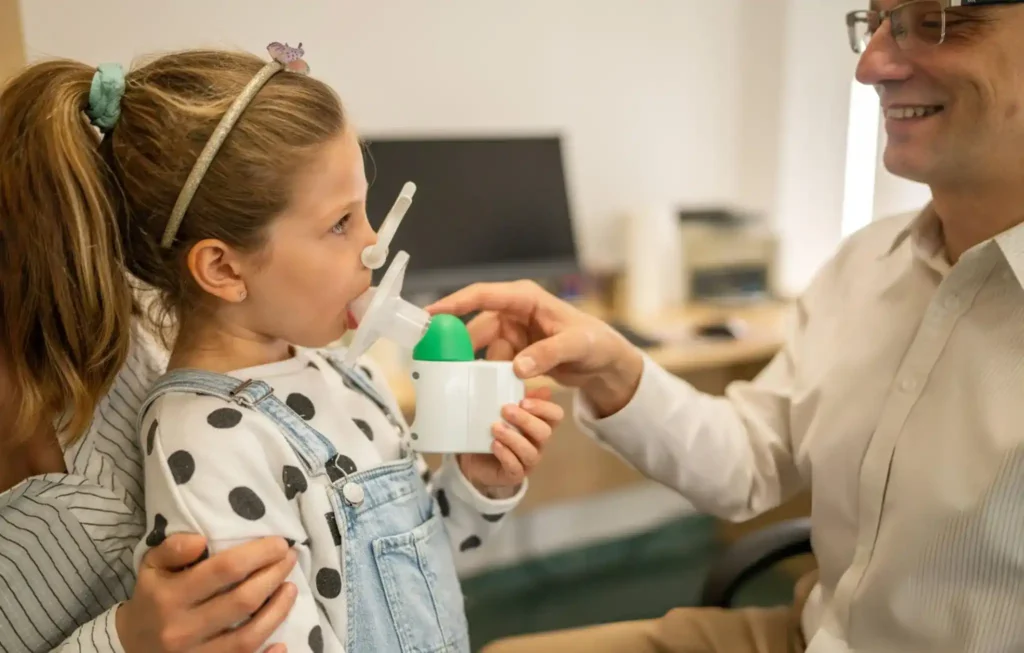
What Is a Spirometry Test? How It Works and What the Results Can Show
Spirometry is a lung-function test that measures how much air you can forcefully breathe out and how quickly you can exhale it. It is commonly used to help assess symptoms such as persistent cough, wheeze, breathlessness, or chest tightness.
The results can provide useful information when investigating conditions such as asthma or COPD, but they are always interpreted alongside symptoms, medical history, and clinical assessment rather than used alone.
Key Takeaways
- Spirometry measures how much air you breathe out and how fast you can expel it.
- FEV1, FVC, and their ratio are the key measurements.
- Repeated breathing efforts are needed to get reliable results.
- The test may be repeated after a bronchodilator to compare airflow.
- Results need interpretation alongside your symptoms and medical history.
Why Would a GP Recommend a Spirometry Test?
A GP may recommend spirometry when persistent breathing symptoms need further assessment. This can include:
- a cough that has been present for several weeks
- recurring wheeze or noisy breathing
- unexplained breathlessness or reduced exercise tolerance
- chest tightness, particularly after activity
- suspected asthma or COPD
- monitoring an existing respiratory condition over time
The Australian Asthma Handbook identifies spirometry as the most established lung-function test for demonstrating variable airflow limitation when asthma is being investigated. Post-bronchodilator spirometry is also central to confirming persistent airflow obstruction when COPD is suspected.
If cough, wheeze, or breathlessness is persistent, a GP assessment for persistent breathing symptoms can help clarify whether spirometry or another respiratory assessment may be appropriate.
What Happens During a Spirometry Test?
The test is non-invasive. No needles or imaging are involved. Here is what usually happens:
- The clinician explains the procedure before you begin.
- A nose clip may be placed over your nose to ensure all airflow goes through the mouthpiece.
- You take the deepest breath you can manage.
- You seal your lips firmly around the mouthpiece.
- You blow out as hard, as fast, and for as long as you can.
- The manoeuvre is repeated until reliable, consistent measurements are obtained.
You will usually need to repeat the breathing effort several times. This is not because earlier attempts were unsuccessful – it is because reliable spirometry requires consistent results across multiple acceptable manoeuvres.
Some people may briefly feel light-headed, breathless or tired after repeated efforts. These symptoms usually settle with rest.
What Do FEV1, FVC and the FEV1/FVC Ratio Mean?
These are the three key measurements your clinician will review. Here is what each one means in plain English:
| Measurement | What it measures |
| FEV1 | How much air you forcefully breathe out in the first second |
| FVC | The total amount of air you forcefully breathe out after a full breath |
| FEV1/FVC | The proportion of the total forced breath exhaled in the first second |
Your results are interpreted using validated reference equations that consider factors such as age, height and sex at birth. Depending on the reference equation used, ethnicity may also be considered. There is no single universal “normal” number that applies to everyone.
A reduced FEV1/FVC ratio suggests expiratory airflow obstruction, but it does not by itself identify the underlying cause.
Why Is Spirometry Sometimes Repeated After an Inhaler?
When a bronchodilator – a rapid-acting airway-opening medicine – is given during the test, this is called bronchodilator responsiveness testing.
The process works like this:
- Initial spirometry measurements are taken.
- A bronchodilator is given, usually as an inhaler.
- Spirometry is repeated after the medicine has had time to act.
- The clinician compares the measurements from both sets.
This comparison provides useful information about whether airflow changes after an airway-opening medicine. It can assist in assessing conditions such as asthma, where variable airflow limitation is characteristic. Do not stop any prescribed inhaler before your test unless your testing provider has specifically advised you to do so.
What Can Spirometry Results Show?
Results generally fall into a few broad patterns.
Normal pattern
Measurements fall within the expected range based on appropriate reference values for the individual.
Obstructive pattern
A reduced FEV1/FVC ratio suggests expiratory airflow obstruction. This pattern may occur with conditions such as asthma or COPD, but the result alone does not confirm either diagnosis.
Possible restrictive pattern
A reduced FVC with a normal or increased FEV1/FVC ratio may suggest a restrictive pattern. Spirometry alone cannot confirm restriction, so full lung-volume testing may be required.
Spirometry shows a pattern of lung function. It does not identify the cause by itself.
Can Spirometry Diagnose Asthma or COPD?
Asthma
Spirometry can provide objective evidence of variable airflow limitation and bronchodilator responsiveness, which supports an asthma assessment. It is interpreted alongside typical symptoms and clinical history rather than used as a standalone diagnostic test.
COPD
Post-bronchodilator spirometry is used to help confirm persistent airflow obstruction when COPD is suspected, alongside relevant symptom history and exposure to smoke, dust, or fumes. For patients with an established respiratory condition, ongoing chronic disease management can help with long-term monitoring and care.
Can Spirometry Be Normal Even With Symptoms?
Yes. A normal spirometry result does not rule out every respiratory condition. Asthma, for example, can sometimes produce normal spirometry between symptomatic periods. If symptoms persist after a normal result, further assessment or repeat testing may be discussed with your GP.
How Should You Prepare for a Spirometry Test?
Follow the instructions provided by the clinic or testing provider. In general:
- Do not stop prescribed inhalers without specific advice from the clinic.
- Wear clothing that does not restrict breathing or chest movement.
- Tell the testing provider about any recent respiratory infection, surgery, significant heart or lung condition, or other health issue that may affect testing.
- Follow any instructions provided about meals, smoking, or exercise before the test.
Preparation instructions can vary depending on the type of spirometry and its purpose.
What Happens After a Spirometry Test?
A GP will review the results alongside your symptoms, medical history, and relevant factors such as smoking history, occupational exposure, or existing conditions. Depending on the findings, next steps may include:
- observation or a follow-up appointment
- treatment review or new treatment discussion
- repeat spirometry
- further lung-function testing
- imaging
- referral to a respiratory specialist
A general medicine consultation can support this review if you are waiting for results or have questions about your findings.
Conclusion
Spirometry is a practical, non-invasive lung-function test that measures airflow and the amount of air you can breathe out. The results – including FEV1, FVC, and the FEV1/FVC ratio – provide useful information about respiratory function when interpreted alongside your symptoms and medical history.
Results support clinical assessment. They are not a standalone diagnosis.
If you are in Valentine, NSW and have persistent breathing symptoms or questions about a recent spirometry result, a GP can help you understand what the findings mean for your individual situation.
Patients in Valentine can book a GP appointment at Valentine Healthcare to discuss ongoing breathing symptoms, previous lung-function results, or appropriate next steps.
FAQs
What does a spirometry test measure?
Spirometry measures how much air you can forcefully breathe out and how quickly you can exhale it. The key measurements are FEV1, FVC, and the FEV1/FVC ratio, which together can indicate patterns of airflow.
Does a spirometry test hurt?
Spirometry is non-invasive and does not involve needles or imaging. The repeated forced breathing efforts may briefly cause breathlessness, light-headedness, or tiredness in some people, but these effects usually settle quickly.
Can spirometry diagnose asthma?
Spirometry can provide objective evidence supporting an asthma assessment, particularly when variable airflow limitation is demonstrated. Results are interpreted alongside symptoms and clinical history rather than used as a standalone diagnosis.
What does a low FEV1/FVC ratio mean?
A reduced FEV1/FVC ratio suggests expiratory airflow obstruction. Further clinical assessment is needed to identify the underlying cause, as this pattern can occur with several respiratory conditions.
Can spirometry be normal if I still have breathing symptoms?
Yes. Normal spirometry does not exclude every respiratory condition. Symptoms that persist after a normal result may require further assessment or repeat testing in a different clinical context.